

Your executive walks out of a strategy meeting and straight into a client call. Somewhere in that first conversation, a deadline moved, a promise was made, and someone said, “Let’s reconnect in two weeks.” By tomorrow morning, who will remember?
If you are an administrative or executive assistant, this is the part of meeting management no one ever trained you for. Sending the invitation is easy. Managing everything a meeting sets in motion is where the real work, and your real value, lives.
Meetings Have Changed. Has Your Approach to Meeting Management?
The meeting landscape looks very different than it did even a few years ago. Microsoft’s 2023 Work Trend Index found that the average employee spends 57% of their time in Microsoft 365 communicating through meetings, email, and chat, and 68% of people say they lack enough uninterrupted focus time. In 2025, Microsoft reported that nearly a third of meetings now span multiple time zones, up 35% since 2021, and that workers are interrupted roughly every two minutes during core hours.
Now picture your executive inside those numbers. Back-to-back meetings with no transition time. Teams spread across cities and countries. Hybrid calls where remote participants quietly become observers. AI-generated transcripts and summaries piling onto an already crowded inbox.
In that environment, meeting management can no longer mean simply finding an opening on the calendar, sending the link, and typing up minutes. It requires you to think about everything surrounding the meeting: what it needs to accomplish, who really needs to be there, what your executive needs before walking in, what could go wrong, and what has to happen because the meeting occurred.
That is the thinking behind The Administrative Professional’s Guide to Modern Meeting Excellence. I have spent decades observing meetings from every angle, first as an administrative professional and later as a trainer, coach, business owner, and CEO. Since founding Office Dynamics International in 1990, I have worked with administrative professionals, executives, and executive-assistant teams across industries and organizations of every size. I’ve seen exceptionally well-run meetings, and I’ve seen the opposite: meetings where people leave with no clarity on what was decided, who owns what, or what happens next.
These experiences have convinced me that you, the administrative professional, can have a far greater impact on meeting effectiveness than we realize.
Meeting Management Is a Thinking Skill, Not a Checklist
Consider what is actually happening when you prepare an important executive meeting. You may be coordinating people with competing schedules and priorities, gathering information from multiple sources, managing a series of deadlines, determining what your executive needs to know, and considering what participants need in order to contribute effectively. At the same time, you may be watching for potential barriers, changes, missing information, and downstream consequences. That is much more than meeting logistics.
Meeting management calls upon some of the most important capabilities of today’s administrative professional:
- Critical thinking and judgment
- Organization and time management
- Communication and information flow
- Problem solving
- Anticipation and Plan B thinking
- Future-focused thinking
- Strategic executive partnership
These skills do not operate independently. They work together as you continually evaluate what’s happening now, what’s missing, and what may happen next. A checklist can remind you to test the technology or distribute the agenda, but it can’t tell you whether the wrong people have been invited or whether your executive is walking into the meeting without critical context.
A checklist can remind you what to do. It can’t do the thinking for you.
The shift starts with a single question. Most meeting planning begins with “When is everyone available?” Modern meeting management begins with “What are we trying to accomplish?” A meeting to share information is different from one designed to make a decision. That answer shapes who attends, how long you need, what people must prepare, and what follow-up will be required.
The Two Pathways of Meeting Management for Executive Assistants
Most meeting resources focus on one thing: the meetings you arrange for your executive. But you actually experience meetings from two different sides.
Pathway 1: You are the attendee or host. You sit in department meetings, project meetings, committees, and planning sessions. Sometimes you lead them. Here the standard is personal accountability.
When you’re the attendee, do you review the agenda beforehand and understand why you’re there? Do you arrive prepared to contribute rather than simply listen? If you made a commitment at the previous meeting, do you know its status before someone asks? And when the meeting ends, do you capture your own action items, dates, and follow-up responsibilities?
When you’re the host, your responsibilities expand even further. You’re thinking about the purpose, participants, timing, agenda, materials, technology, and overall experience. More importantly, you should be asking whether people have what they need to participate effectively.
Sending information is not the same thing as preparing people.
Then There Are the Meetings You Never Attend.
Pathway 2: You are supporting your executive. This is where most of the work lives.
Many administrative professionals support executives who spend most of their day in meetings that their assistants never attend. Those meetings matter to you because they generate decisions, commitments, deadlines, requests, new priorities, calendar changes, and additional meetings. Your executive may suddenly need a document, a piece of data, a contact, or an adjustment to the next appointment. Supporting an executive’s meeting does not necessarily require being in the room.
This requires a different kind of readiness. You need enough context to respond intelligently, an awareness of what is happening around the executive’s calendar, and the ability to retrieve information quickly. You also need judgment about when to intervene and when to protect the meeting from unnecessary interruptions.
You do not have to be in the meeting to support the meeting.
The Three Phases of Modern Meeting Management
Whether you are attending or supporting, the guide frames meeting management as a complete lifecycle in three phases:
- Pre-Meeting: Think. Plan. Prepare. Anticipate. What needs to happen before the meeting so the people involved can succeed?
- Meeting Proper: Participate. Support. Observe. Adapt. What needs your attention while the meeting is taking place?
- Post-Meeting: Capture. Follow Through. Debrief. Close the Loop. What needs to happen because the meeting occurred?
These phases sound simple. What separates an exceptional administrative professional is the thinking inside each one. Here’s a taste.
Pre-Meeting: Start With Purpose, Not the Calendar
Protect people’s time. More participants do not make a better meeting. A one-hour meeting with eight people represents at least eight hours of organizational capacity before anyone prepares or follows up. Sometimes the smarter move is to consult someone beforehand or brief them afterward.
Work backward from the meeting date. A Friday meeting is rarely one deadline. Participants need materials Wednesday. Your executive needs review time Tuesday. The presenter’s slides are due Monday. The data behind those slides is due the Thursday before. You need to manage a sequence, not a date.
Prepare people, not just documents. Sending a 30-page report shortly before the meeting technically counts as distributing it in advance. It does not mean anyone could prepare. Microsoft’s 2025 research found that PowerPoint edits spike 122% in the final 10 minutes before meetings, which tells you how often materials are still moving at the last minute.
Prepare your executive. You may have spent a week on one meeting. Your executive may have ten others that day. Never assume the context that is fresh in your mind is equally fresh in his or hers. The guide details exactly what belongs in a strong executive briefing, and what to leave out so you inform rather than overwhelm.
Have a Plan B. The goal is not to worry about everything. It’s to identify the barriers that are most likely or most consequential, so you can respond rather than react.
Meeting Proper: You Don’t Have to Be in the Room
Here is one of the guide’s Modern Meeting Realities: You don’t have to be in the meeting to support the meeting.
When your executive is in a meeting without you, your role shifts from observing to being ready. I call it presence without hovering. That means knowing where information lives, watching the surrounding calendar, knowing your executive’s preferred way to reach you, and understanding what truly counts as urgent.
It also means that you think about ripple effects. If a meeting scheduled to end at 10:00 is clearly still going at 9:55, what happens to the 10:00? Who needs a heads-up? Does a later commitment need to move? Strong meeting management solves what falls within your responsibility before handing a problem to your executive.
Post-Meeting: The Meeting Is Over. The Work Isn’t.
One of the greatest missed opportunities in executive-assistant partnerships happens after the meeting. Post-meeting management today is much more than typing and distributing minutes. An executive may move through several meetings in a day, making decisions, agreeing to deadlines, promising follow-up, and receiving new information along the way.
Then the next morning arrives, the calendar fills up again, and everyone moves forward. Yesterday’s meetings disappear beneath today’s activity.
The modern assistant asks, “Where does this information need to go next?” A single decision might need to become a calendar entry, a task, a project update, a Teams or Slack message, a document revision, or another meeting.
This is discovered in a meeting debrief.
It’s not realistic for an assistant to debrief the executive immediately after every meeting, and that’s not what I recommend. Instead, during your next executive-assistant touch base, take a few minutes to pull up the previous day’s calendar and review the significant meetings. Some will require nothing, so move on quickly. Others may have generated important information that needs to enter your workflow.
Listen for things such as:
- What was decided?
- What did your executive commit to?
- What did someone commit to your executive?
- What action items or deadlines were established?
- Does another meeting need to be scheduled?
- Who needs information?
- Did anything change that affects today’s priorities?
This doesn’t need to be a lengthy recap of everything that was discussed. You’re looking for the outcomes that need to be moved forward. A promise may need to become a task, a date may need to go on the calendar, a follow-up may need to be scheduled, or a change in direction may need to be communicated to someone else.
Yesterday’s meetings create today’s work.
This practice also strengthens your ability as an assistant to anticipate. We’re often told to be more proactive, think ahead, and anticipate their executives’ needs, but there is an important prerequisite to all three. You need information and context.
You can’t manage information you don’t have, and you can’t consistently anticipate from incomplete information.
Today’s Workplace Raises the Standard
Modern meetings are taking place in a work environment that has changed dramatically. Teams may be distributed across locations and time zones, which means people no longer receive as much context through informal hallway or office conversations. Executives are operating at tremendous speed, often without enough transition time between meetings. Meanwhile, the sheer volume of information surrounding every meeting has increased.
Technology and AI are changing meeting management as well. AI can help draft agendas, organize notes, summarize transcripts, identify possible action items, and structure information. Those capabilities can save tremendous time, but you still need to assess accuracy, context, ownership, confidentiality, priorities, and what should happen next.
Technology can capture words. The administrative professional provides context, judgment, discretion, and continuity.
Think Beyond the Meeting
The biggest change I encourage administrative professionals to make is to stop viewing a meeting as an isolated event on the calendar. The modern post-meeting question is not simply, Did I distribute the notes? It’s Where does this information need to go next?
That’s where meeting management intersects with information flow, executive partnership, accountability, and closing the loop. A meeting can feel highly productive while everyone is sitting around the table, but if commitments disappear afterward, very little was actually accomplished. As an administrative professional, you can create continuity between the conversation and the work that follows. That’s a significant contribution.
From Meeting Planning to Modern Meeting Management
After decades in the workplace and decades of working with administrative professionals and executives, I believe we need to raise our expectations around this fundamental responsibility. Today’s administrative professional is capable of contributing far beyond meeting logistics. The opportunity is to understand the entire meeting lifecycle and bring your thinking, judgment, anticipation, and follow-through to every phase.
Don’t simply schedule a meeting. Understand why each meeting matters.
Don’t simply send the materials. Prepare people to contribute.
Don’t simply react when circumstances change. Anticipate barriers and have a Plan B.
And don’t assume the meeting ends when everyone leaves. Capture the decisions, commitments, dates, and information that need to move forward. Look back at yesterday’s meetings long enough to understand what they created for today, and then look ahead to what needs to happen next.
That’s the shift from traditional meeting planning to Modern Meeting Excellence.
And it’s one more way that administrative professionals can demonstrate the extraordinary value they bring to their executives, teams, and organizations every day.
The Meeting May End. Your Impact Continues.
Meetings will keep changing. Technology will keep evolving. But the need for administrative professionals who can see the bigger picture is not going away.
Don’t simply manage meetings. Manage what surrounds them. Think ahead, prepare people, anticipate what others miss, capture what matters, and close the loop.
From Meeting Planning to Modern Meeting Management
Here is a glimpse of the mindset shift the guide is built around:
| Traditional thinking | Modern meeting excellence |
|---|---|
| Find an opening on the calendar. | Consider purpose, priorities, preparation, transition time, time zones, and executive capacity. |
| Send the materials. | Make sure people have what they need, early enough to prepare and contribute. |
| Take minutes. | Capture decisions, commitments, owners, deadlines, and what happens next. |
| The meeting is over. | Ask what the meeting created and move decisions and commitments into the workflow. |
The full guide carries this thinking through every phase, with reflection prompts, Modern Meeting Reality insights, and space to apply each idea to the meetings on your own calendar.
Put It Into Practice: The Executive Meeting Support Toolkit
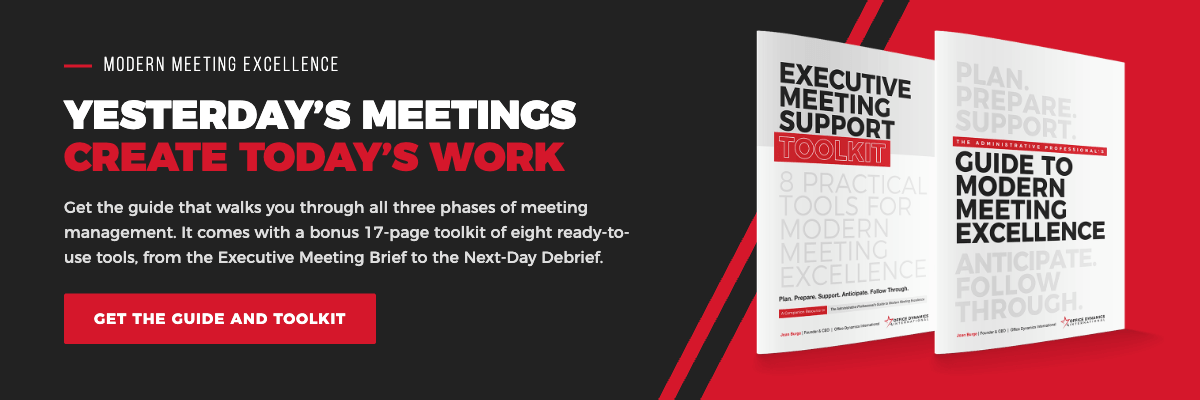
Knowing what excellent meeting management looks like is one thing. Doing it consistently, on a packed Tuesday, is another. That is why the guide comes with a bonus 17-page Executive Meeting Support Toolkit: eight ready-to-use tools that turn the principles into practice.
- Executive Meeting Planning Worksheet: Clarify purpose, outcomes, participants, executive needs, barriers, and Plan B.
- Pre-Meeting Planning Checklist: Review people, timing, agenda, materials, logistics, and preparation.
- Executive Meeting Brief: Organize the context your executive needs to walk in informed.
- Meeting Proper Support Checklist: Stay ready whether you are hosting, supporting, or outside the room.
- Post-Meeting Action Capture: Record decisions, owners, deadlines, unresolved issues, and executive commitments.
- Next-Day Executive Meeting Debrief: Use yesterday’s calendar to uncover what your executive’s meetings created.
- Executive Commitment Tracker: Keep your executive’s promises visible before deadlines slip.
- Meeting Manager’s Final Check: Evaluate the full lifecycle, from preparation to closing the loop.
The Administrative Professional’s Guide to Modern Meeting Excellence is a professional digital guide plus the bonus 17-page toolkit.
Frequently Asked Questions About Meeting Management
What is meeting management?
Meeting management is the work of planning, supporting, and following through on meetings so they produce results. For administrative professionals, it covers the full lifecycle: purpose and preparation before, support during, and capturing decisions and commitments after.
What is an executive assistant’s role in meeting management?
Beyond scheduling and logistics, an executive assistant clarifies purpose, prepares participants and the executive, anticipates barriers, stays ready during meetings, and makes sure decisions and commitments become completed work.
Do executive assistants need to attend meetings to support them?
No. Many executives attend most of their meetings without their assistant. Support means being informed, appropriately available, and ready to act on what those meetings create.
Can AI handle meeting management?
AI can draft agendas, summarize transcripts, and suggest action items. It cannot judge whether an action is accurate, whether the owner is right, or what is sensitive. That judgment still belongs to you.