

Why EA Hiring Fails and How to Fix It
Hiring a strong Executive Assistant feels harder than it used to. Many organizations lean on familiar job boards, only to end up sorting through a mountain of mismatched applicants, running long interview cycles, and still feeling uncertain about fit.
The issue is not that great Executive Assistants disappeared. The issue is that the way top support professionals find roles has shifted. The best candidates are often already employed, selective, and careful about where they invest their talent. They do not want another job. They want the right partnership.
Why job boards alone are not working
Job boards are not useless, but they are rarely sufficient for executive-level support roles. Executive Assistant positions get mixed in with a wide range of administrative postings, each with different seniority, scope, and expectations. That creates noise and confusion on both sides.
Common challenges hiring teams report:
- High applicant volume with low relevance to the actual scope
- Candidates applying broadly without understanding the role
- Difficulty assessing judgment, discretion, and executive presence on paper
- Promising interviews that reveal a gap between experience and readiness
If you are hiring for a true Executive Assistant partnership, you are not simply filling a seat. You are bringing in a trusted extension of an executive’s time, priorities, and communication. That requires a different approach.
Why experienced EAs approach job searches cautiously
One important reality is often overlooked: many high-performing EAs hesitate to apply even when a role looks interesting. Not because they lack confidence, but because they have learned what can go wrong when expectations are vague.
Common concerns top EAs weigh before applying:
- Will the executive truly want a partner, or just an order taker?
- Is the scope clear, or will it expand without support or authority?
- What is the executive’s working style and communication cadence?
- Is this organization stable, respectful, and aligned with executive-level support?
- Will onboarding set the EA up for success, or leave them guessing?
When your job post and process address these questions upfront, you attract higher quality candidates and reduce drop-off during interviews.
Where strong EA candidates are actually coming from
Many of the best Executive Assistants are not actively job hunting. They are listening. They notice opportunities shared by trusted peers, leaders, and professional communities. That is why relationship-based recruiting is outperforming passive posting in many industries.
Professional communities and peer networks
Executive Assistants are deeply connected through private groups, online forums, association networks, and peer referrals. Roles shared within these spaces come with context and credibility.
Referrals from current or former assistants
Your best pipeline might already be in your building. High-performing assistants often know other high-performing assistants. A thoughtful referral strategy can outperform months of posting and sorting.
Targeted LinkedIn outreach
LinkedIn works best when you stop waiting and start initiating. A respectful message that clearly explains scope, executive style, and what success looks like will often earn responses from candidates who are not actively searching.
Training organizations and alumni networks
Professionals who invest in training tend to demonstrate higher standards, stronger self-management, and a commitment to the craft of executive support. Alumni networks and professional development communities can be a strong talent source.
A bad EA hire costs more than time
When an EA hire is misaligned, the cost is rarely limited to recruiting fees or a few weeks of onboarding. The real impact shows up in executive drag, missed priorities, and communication breakdowns.
Common costs of a mis-hire include:
- Lost executive time due to rework, confusion, and constant clarification
- Reduced momentum as the executive and team adapt to an unstable support structure
- Increased confidentiality risk when judgment and discretion are not strong
- Lower team trust when communication flow becomes inconsistent
- Restarting the process after a short tenure exit
This is why rushing the process or relying on volume-based hiring often backfires. The goal is not to hire fast. The goal is to hire right.
How to write a job post that attracts executive-level EA talent
Where you post matters, but how you position the role matters more. Many job descriptions unintentionally repel experienced EAs by sounding vague, transactional, or overloaded.
Be clear about scope and authority
Avoid generic phrases like “support as needed.” Instead, define what the EA owns, what decisions they can make, and where they are expected to lead.
Describe the partnership, not just tasks
Executive-level EAs want to know how they will help the executive win. Tie responsibilities to outcomes such as protecting focus time, improving workflow, strengthening communication, and supporting priorities.
Signal respect for the profession
Language matters. Job posts that highlight trust, confidentiality, critical thinking, and business awareness draw stronger candidates than posts that read like a list of errands.
Give candidates a view of success
Share what the first 30, 60, and 90 days could look like. Clarity creates confidence and helps candidates self-select into the right roles.
What to assess beyond the resume
Resume experience matters, but it is not the full picture. Two candidates can have similar titles and very different levels of readiness. The differentiator is often judgment.
Key areas to evaluate in interviews:
- Judgment under pressure: Ask how they prioritize when everything is urgent and the executive is unavailable.
- Discretion and confidentiality: Look for how they speak about past executives and sensitive situations.
- Decision making: Explore where they take initiative versus where they escalate.
- Communication style: Assess how they manage up, clarify expectations, and keep stakeholders aligned.
- Business awareness: Ask how they stay connected to priorities and anticipate needs.
Simple but powerful interview prompt: “Walk me through how you would set up an executive support system in your first month.” Strong candidates will talk about relationship building, preferences, rhythms, stakeholders, priorities, and the executive’s definition of success.
Hiring an EA requires executive clarity
A truth many organizations overlook is that hiring success is not only about the candidate. It also depends on executive readiness. Even a world-class EA will struggle if expectations are undefined or if the executive has not clarified how they want to work with a partner.
Before hiring, executives should be able to answer:
- What do I want this EA to own versus support?
- What decisions do I want them to make without me?
- How do I communicate, and what do I need from my EA to stay aligned?
- What does success look like in 90 days?
- How will I build trust, feedback, and a shared working rhythm?
When an executive is clear, the hiring process becomes cleaner, the job post becomes more compelling, and the onboarding becomes dramatically smoother.
Hiring an Executive Assistant? Start with clarity.
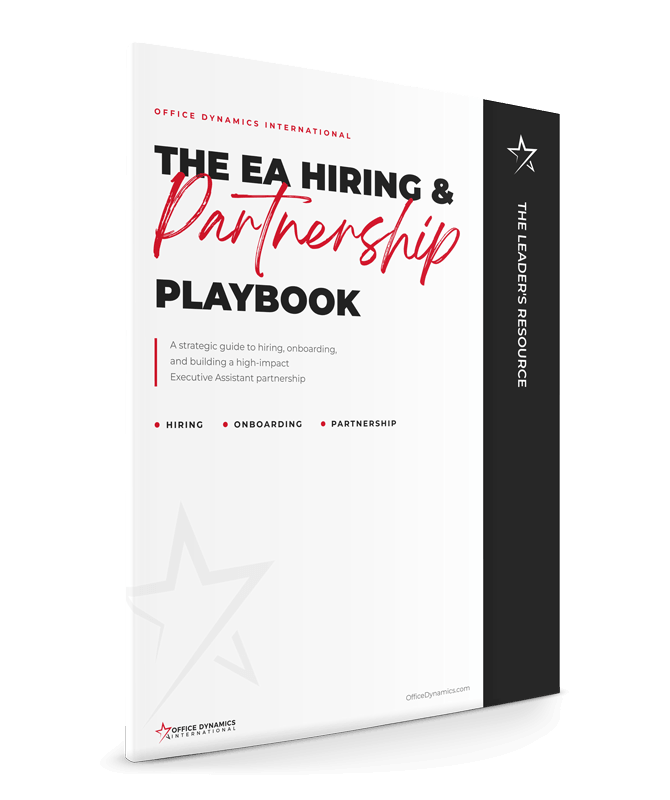
Download The EA Hiring & Partnership Playbook with Bonus Interview Scoring Guide
Hiring an Executive Assistant requires more than a job description. To help leaders navigate readiness, role design, interviews, and onboarding, Office Dynamics International created The EA Hiring & Partnership Playbook, a practical guide for building high-impact executive support partnerships.
How Office Dynamics International can help
At Office Dynamics International, we support organizations that want to hire and develop high-performing Executive Assistants and build strong executive support partnerships.
We can help with:
- Coaching for executives who want to lead and leverage an EA more effectively
- Coaching for Executive Assistants who want to step into a higher-level partnership
- Executive and EA partnership coaching to clarify roles, fit, duties, and expectations
- Onboarding support that helps the EA and executive build trust, rhythm, and clear ownership
- Guidance on what to look for during hiring so you can evaluate readiness, not just experience
If your goal is a true partnership that protects executive time and improves business outcomes, the hiring decision is only the beginning. The right onboarding and alignment plan is what turns a promising hire into a long-term success.
Final takeaway
Hiring EA talent today requires a shift from volume-based recruiting to relationship-based recruiting, and from task-based job posts to partnership-based role design. When you pair smarter sourcing with clearer expectations and stronger onboarding, you do not just fill a role. You build a strategic advantage.