

How to Write Strong EA Resume Achievement Bullets
If your resume reads like a job description, it will blend in. Hiring managers and executives want proof. What improved because you were in the role? What moved faster, cost less, stayed cleaner, or ran with fewer fires?
This guide shows you how to translate everyday EA work into measurable accomplishments, even when you were not handed a dashboard or formal metrics.
Why your resume needs accomplishments, not responsibilities
Responsibilities tell what you were assigned. Accomplishments show what you delivered.
- Responsibilities: Managed executive calendar and travel.
- Accomplishments: Reduced scheduling conflicts for 4 leaders by standardizing meeting buffers and agenda requirements, cutting reschedules by 30% over 90 days.
When you lead with outcomes, you sound more strategic, more credible, and more promotable.
The EA accomplishment formula
Use this simple structure to build strong bullets:
Action verb + what you did + scope + result (number) + tool or stakeholder (optional)
Example:
Boosted meeting efficiency by 20% for a 6-person leadership team by redesigning agendas, adding pre-reads, and enforcing decision owners and due dates.
What counts as a “number” on an EA resume
Numbers are not only dollars. Think in five buckets and choose 1 to 2 per bullet.
- Time: minutes saved, cycle time reduced, turnaround improved
- Accuracy: fewer errors, fewer corrections, fewer escalations
- Cost: savings, avoided fees, negotiated rates, reduced waste
- Volume: number of leaders supported, meetings, requests, events, invoices
- Experience: satisfaction, adoption, fewer complaints, smoother execution
How to find metrics when nobody tracks them for you
You can usually pull credible estimates from systems you already touch. Start with what you can verify, then tighten the number later.
Where to look
- Calendar: meeting counts, meeting length, reschedules, no-agenda meetings
- Email and chat: response time, number of follow-ups avoided through better tracking
- Expense tools: corrections, late submissions, policy issues, and closeout time
- Travel: average cost per trip, change fees avoided, lead time improved
- Project tools: throughput, on-time completion, fewer dropped handoffs
- Events: attendance, budget variance, vendor savings, satisfaction feedback
Good “assistant math” (simple and defensible)
- Time saved: (minutes saved per occurrence) x (occurrences per week/month)
- Error reduction: (errors before – errors after) / errors before
- Cost savings: old rate – new rate, or avoided fee x count
- Cycle time: average days before vs after your process change
Tip: If you must estimate, do it conservatively and be ready to explain the method in an interview.
Ready to Write Strong EA Resume?
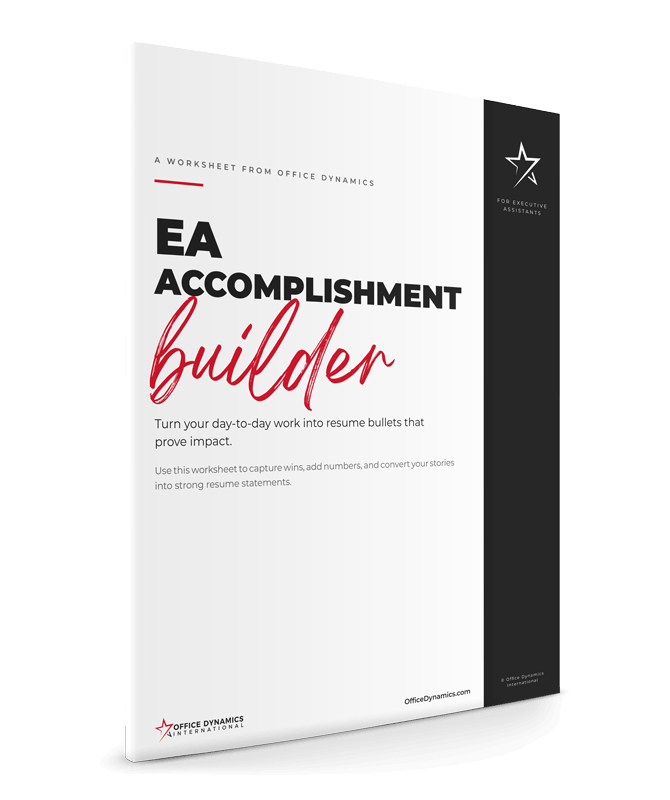
Download: EA Accomplishment Builder Worksheet
Want a faster way to capture wins and convert them into resume bullets? Use the companion worksheet to brainstorm achievements, add numbers, and write polished bullets.
40 quantifiable EA accomplishment examples (copy and customize)
Use these as templates. Replace brackets with your scope, tools, and results.
Calendar and meeting efficiency
- Reduced reschedules by [X%] for [X leaders] by implementing meeting criteria (agenda required, decision owner, time cap).
- Cut average meeting length from [X] to [X] minutes by introducing agenda blocks and timekeeping.
- Boosted meeting efficiency by [X%] by standardizing pre-reads and capturing decisions and action owners in real time.
- Reclaimed [X] hours per week for the executive by consolidating recurring meetings and removing low-value invites.
- Improved stakeholder responsiveness by [X%] by adding a follow-up tracker and weekly action review.
- Reduced double-bookings from [X] per month to [X] by rebuilding calendar rules and buffer logic.
Travel and logistics
- Reduced travel costs by [$X] per quarter by renegotiating preferred hotel rates and tightening booking windows.
- Cut change fees by [X%] by confirming agendas and approvals [X] days earlier.
- Supported [X] trips per month with zero missed connections by implementing a standardized itinerary and check-in process.
- Reduced trip planning cycle time from [X] days to [X] days by creating reusable templates and vendor lists.
Expenses, purchasing, and finance support
- Reduced expense errors by [X%] by building a submission checklist and training [X] frequent travelers.
- Cut month-end closeout time by [X] hours by standardizing receipts, coding, and approvals.
- Recovered [$X] in duplicate charges by auditing statements and disputing vendor errors.
- Improved on-time submissions from [X%] to [X%] by implementing reminders and a due-date cadence.
- Reduced rush purchase requests by [X%] by building a forecasting and reorder cadence with key stakeholders.
Process improvement and documentation
- Created [X] SOPs that reduced onboarding time from [X] weeks to [X] weeks for new team members.
- Improved request turnaround by [X%] by implementing an intake form and triage rules.
- Reduced rework by [X%] by standardizing document templates and approval steps.
- Built a knowledge base that cut repeat questions by [X%] within [X] months.
Event and offsite management
- Managed a [X]-person offsite with a [$X] budget and finished [$X] under budget.
- Negotiated vendor terms that saved [$X] while meeting all compliance requirements.
- Improved attendee satisfaction from [X] to [X] (survey score) by updating the agenda flow and communications.
- Delivered [X] events with zero missed deadlines by creating a repeatable planning timeline and ownership map.
Executive communication and stakeholder management
- Improved response times by [X%] by creating a prioritization system for executive inbox requests.
- Reduced follow-up loops by [X%] by implementing decision logs and clear next steps after meetings.
- Prevented [X] deadline slips by tracking dependencies and escalating risks earlier.
- Supported [X] cross-functional teams by coordinating updates, notes, and action tracking across time zones.
Tools, automation, and AI support
- Saved [X] hours per month by automating recurring admin tasks using [tool] and standardized templates.
- Reduced manual reporting time by [X%] by building a tracker in [Excel/Sheets] with clean inputs and summaries.
- Improved data accuracy by [X%] by implementing validation steps and clear naming conventions.
- Increased adoption of a new tool to [X%] of the team by creating quick guides and hosting [X] training sessions.
Before-and-after: how to upgrade weak bullets fast
Weak: Managed calendars and meetings.
Stronger: Reduced reschedules by 30% for 3 executives by implementing agenda requirements, time caps, and meeting buffers.
Weak: Handled expenses.
Stronger: Reduced expense corrections by 25% by introducing a submission checklist and weekly audit, speeding reimbursements by 2 days on average.
Weak: Coordinated an offsite.
Stronger: Delivered a 40-person leadership offsite on a $35K budget, negotiating vendor terms that saved $4,200 and improved attendee satisfaction to 4.7/5.
Tailor accomplishments to the job you want
One of the biggest resume misses is using the same bullets for every role. Instead:
- Circle repeated themes in the job description (calendar complexity, travel volume, board support, events, project coordination).
- Pick accomplishments that match those themes.
- Mirror relevant tools and language (without copying entire phrases).
Common mistakes that make EA accomplishments sound smaller
- Listing tasks without outcomes
- Using vague phrases like “assisted with” when you owned the work
- Hiding scope (how many leaders, how many meetings, what size budget)
- Skipping the “why it mattered” to the business
- Overloading one bullet with too many ideas
A simple plan to build your next 10 bullets
- Write a “win list” from the last 6 to 12 months.
- Choose 10 wins that show range (time, cost, quality, leadership support).
- Add scope and one metric to each.
- Rewrite into the formula: action + scope + result.
- Save proof sources (emails, calendar data, reports, feedback) in a folder.
Final thought
Your role is not “just support.” You protect time, reduce risk, improve communication, and keep work moving. When your resume proves that in numbers, you stop competing on personality and start competing on impact.