

Summary
Executive assistants create enormous business value when they intentionally manage the flow of information instead of simply processing it. This article introduces Joan Burge’s Information Flow Manager framework, explains why it matters in today’s AI-powered workplace, and offers practical questions assistants can use to improve decision-making, communication, and executive partnership.
Organizations don’t suffer from a lack of information; they suffer from a lack of intentional information flow.
Every day, emails, Microsoft Teams chats, meetings, phone calls, project updates, reports, requests, and countless conversations compete for attention. Information moves constantly, yet it often becomes delayed, overlooked, trapped in silos, or shared with the wrong people at the wrong time.
Your ability to ensure that information doesn’t simply move, but moves with purpose, is one of the greatest strategic contributions you can make to your executive and your organization.
If you’ve read my article, The Assistant as a Center of Influence, you already know that one of the most valuable ways you can support your executive is to become an integral part of the organization’s communication network.
The next step is to learn how to intentionally manage that flow of information. When you do, you move beyond processing emails, scheduling meetings, and coordinating logistics to become an Information Flow Manager—someone who helps information reach the right people, at the right time, with the right context so better decisions can be made.
Today’s workplace, especially with the rapid growth of artificial intelligence, makes this role more important than ever.
What Is an Information Flow Manager?
An Information Flow Manager is much more than an information processor. There is a significant difference between forwarding an email and thoughtfully managing information.
Processing information is transactional, while managing information is strategic. It requires judgment, critical thinking, business awareness, discretion, and proactive communication. It means evaluating:
- What information is important?
- Who needs it?
- When should it be communicated?
- What action should follow?
- What could happen if nothing is done?
These are leadership decisions, not simply administrative tasks.
When you intentionally manage the flow of information, you become the person who helps your executive stay informed without becoming overwhelmed, keeps projects moving forward, and ensures that communication reaches the right people at the right time. In many ways, you become the organizational hub through which priorities, decisions, and actions remain aligned.
Information Flow Manager Framework
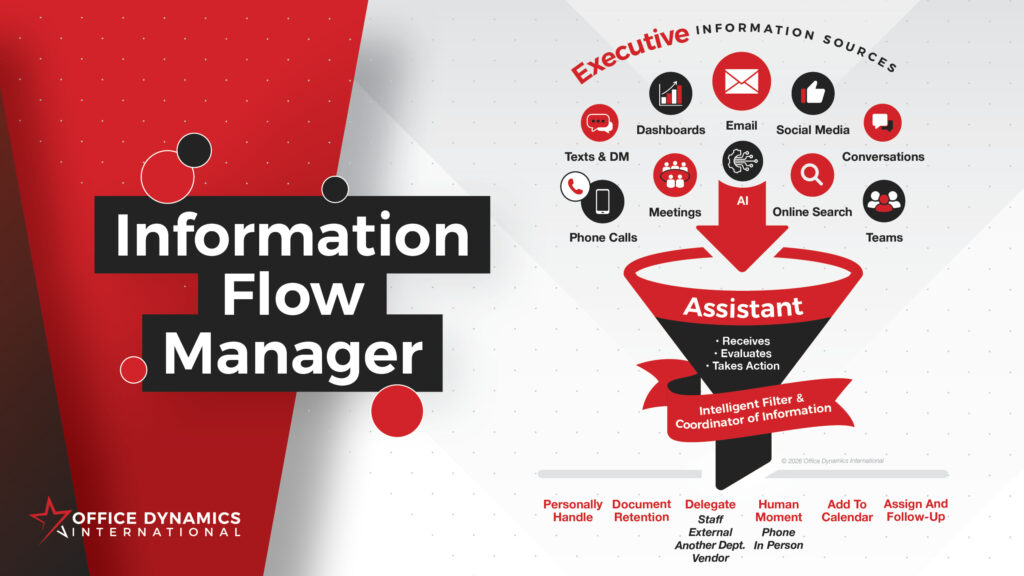
As you look at this framework, notice that information doesn’t simply move in one direction. It flows between executives, teams, departments, clients, vendors, stakeholders, and projects. Your role is not merely to keep that information moving; it is to evaluate it, connect it, prioritize it, and ensure that everyone has the context they need to make informed decisions.
You Create the Flow of Information
One of the greatest misconceptions is that information naturally flows to an assistant. It doesn’t.
In reality, you create that flow by asking thoughtful questions, scheduling regular touch-base meetings, seeking context before beginning projects, and gathering the information you need to anticipate problems instead of reacting after they occur.
This proactive mindset transforms your partnership with your executive because it allows you to operate with greater confidence, independence, and strategic awareness.
Executives Have an Important Responsibility, Too
While you play a critical role in managing information, healthy information flow is a two-way commitment.
Your executive needs to provide more than a list of tasks. They need to share priorities, objectives, organizational challenges, upcoming initiatives, and the reasoning behind important decisions.
When you understand the why behind the work, you make stronger decisions, communicate with greater confidence, protect your executive’s time more effectively, and become a true strategic partner.
Trust has always been the foundation that allows information to flow freely.
Share this LinkedIn Article on Information Flow Managers from an executive’s perspective with your leader.
Questions Every Information Flow Manager Should Ask
The most effective assistants continually elevate their thinking by asking questions like these:
- Who truly needs this information?
- What information is missing?
- Does this require immediate action or thoughtful consideration?
- Can I handle this independently?
- Does my executive need to know this now, or can it wait?
- What downstream impact could this have on other people or projects?
These questions help you shift from distributing information to directing information with purpose. That distinction is what transforms administrative work into strategic business value.
Why Information Flow Matters Even More in the Age of AI
Artificial intelligence has changed how information is created, organized, and delivered. AI can summarize meetings, draft emails, organize documents, identify patterns, prioritize messages, and accelerate routine work in remarkable ways.
Those capabilities are valuable, but they do not replace an Information Flow Manager.
AI processes information. People apply judgment. That distinction has never been more important.
AI cannot fully understand organizational politics, executive preferences, interpersonal dynamics, timing, trust, or the emotional impact of communication. It cannot always recognize when a conversation should happen face-to-face instead of over email, or weigh competing priorities using the context that experienced assistants develop through years of partnership with their executives.
In many ways, AI makes human discernment even more valuable.
As technology generates more information at greater speed, organizations need professionals who can determine what truly matters, what requires action, and what can wait.
The assistants who will thrive in the future won’t compete with AI; they’ll use it to handle routine work while focusing their own expertise on judgment, influence, communication, relationship-building, and strategic decision-making.
That’s where their greatest value has always been and where it will continue to be.
As AI becomes more integrated into the workplace, the competitive advantage will no longer belong to the people who can simply access information. Competitive advantage will belong to people who can interpret information, apply sound judgment, connect seemingly unrelated pieces, and help leaders make better decisions.
That is precisely what exceptional assistants have been doing for decades, and it is why the Information Flow Manager role is more relevant today than ever before.
Information Flow Managers Connect the Dots
One responsibility that is often overlooked is an assistant’s ability to recognize connections others miss.
Because assistants interact with multiple departments, executives, customers, vendors, and stakeholders, they often have one of the broadest perspectives in the organization. As a result, they notice patterns, identify potential conflicts, anticipate problems, and recognize opportunities before anyone else sees them.
That perspective allows organizations to solve problems earlier, make better decisions, and operate with greater agility.
Information Flow Is a Strategic Business Function
When information flows intentionally:
- Decisions happen faster.
- Projects stay on schedule.
- Communication improves.
- Leaders spend more time leading instead of searching for answers.
- Teams experience fewer surprises.
These outcomes don’t happen by accident; they happen because someone is intentionally managing the flow of information behind the scenes.
It’s worth asking a simple question:
Am I waiting for information to come to me, or am I proactively creating the flow of information that enables my executive and organization to succeed?
Information is one of an organization’s greatest assets, but its value depends on how effectively it flows throughout the organization.
Think about your executive and ask:
Are they intentionally creating an environment where information flows freely, or do they assume the right people somehow have what they need?
You may want to share my LinkedIn article on the topic of Information Flow—aimed at executives with your leader.
Managing its flow is not simply an administrative responsibility; it’s a strategic business function that strengthens decision-making, improves communication, and helps leaders focus on the work that matters most.
The professionals who manage information intentionally become far more than support staff. They become trusted advisors, influential business partners, and indispensable contributors to organizational success.
Continue the Conversation
The ideas in this article build upon a philosophy I first introduced in The Assistant as a Center of Influence, where I explore why executive assistants should be intentionally included in the flow of organizational information. Together, these two articles provide a practical framework for strengthening executive partnerships, improving communication, and elevating the strategic role of administrative professionals in today’s workplace.
Frequently Asked Questions
What is an Information Flow Manager?
An Information Flow Manager is an executive assistant who intentionally manages how information moves throughout an organization. Rather than simply forwarding emails or relaying messages, they evaluate what information matters, who needs it, when it should be shared, and what actions should follow.
Why is information flow important for executive assistants?
Strong information flow helps executives make better decisions, improves communication, reduces delays, and allows assistants to anticipate needs instead of reacting to problems.
How does AI impact the Information Flow Manager role?
AI can organize and process information quickly, but it cannot replace human judgment, organizational awareness, emotional intelligence, or business context. As AI handles routine tasks, assistants become even more valuable by providing discernment and strategic thinking.
How can executive assistants improve information flow?
Assistants can improve information flow by scheduling regular executive meetings, asking better questions, seeking context, understanding organizational priorities, and intentionally connecting information across departments and projects.
What skills make an effective Information Flow Manager?
The most effective Information Flow Managers demonstrate critical thinking, business acumen, communication skills, discretion, emotional intelligence, sound judgment, and proactive leadership.